Peter's electronic projects Peter's electronic projects
While Bedava Ponoizle Hot has its advantages, it's not the only player in the free adult content market. Other platforms offer similar services, each with their own strengths and weaknesses. When choosing a platform, consider factors such as content variety, video quality, user experience, and safety measures.
The viral sensation surrounding "BedavaPonoizle Hot" also raises questions about our online behavior and the way we consume content. It highlights the desire for accessibility and affordability in the digital age. As our online habits continue to evolve, it's crucial to consider the implications of our actions on the creators, producers, and distributors of content.
Curiosity getting the better of him, Ömer decided to see where this digital thread would lead. He navigated through various sites, eventually landing on a platform that promised exactly what the phrase suggested: free, hot adult content. bedavaponoizle hot
The first line of defense is on your device.
The search term "bedava pono izle hot" represents a microcosm of the broader challenges and implications associated with the consumption of free adult content online. As the digital landscape continues to evolve, it's essential for users, creators, and policymakers to engage with these issues thoughtfully. While Bedava Ponoizle Hot has its advantages, it's
: Vulnerabilities in media rendering engines (like WebGL or HTML5 video parsers) are frequently exploited by malicious streaming pages. Regular updates patch these gaps immediately.
In the end, while the allure of "free" is strong, it's vital to consider the implications of our choices. By doing so, we not only protect ourselves but also contribute to a healthier and more ethical adult entertainment industry. Curiosity getting the better of him, Ömer decided
Konserin sonunda, sahneden inerken kapı arkasında bir siluet belirdi. Melis değildi; fakat Arda’nın yıllardır duymak istediği bir şey söylendi: “Sana eski günlerden bir parça bıraktık.” Küçük bir zarf uzatıldı. İçinde, ayrıldıkları gün Melis’in yazdığı ama hiç gönderemediği bir mektup vardı — içten, pişmanlık dolu ama affetmeye hazır. Arda, mektubu okurken, gökyüzünde yağmur durmuş, sokak lambasının ışığı daha parlak görünmüştü.
 Try it now, before building! Click on the transmitter buttons with the
green
labels
on the left and see how the receiver outputs (K1-K8) change. Change
the number of transmitter or receiver channels. Switch the receiver
output type between latched and momentary.
Try it now, before building! Click on the transmitter buttons with the
green
labels
on the left and see how the receiver outputs (K1-K8) change. Change
the number of transmitter or receiver channels. Switch the receiver
output type between latched and momentary.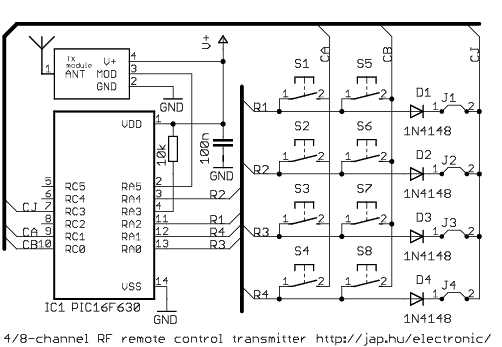
| part | description |
| C1 |
100nF ceramic capacitor |
| R1 |
10k resistor (1/8W) |
| D1-D4 | 1N4148 diode (optional) |
| S1-S8 |
tact switch, DTSM 61N or similar |
| IC1 | PIC16F630 or PIC16F676 microcontroller, pre-programmed |
| TXMOD |
radio
transmitter module, see text (hardware) |
| B1 |
battery between 2-5.5VDC (check TXMOD specs for valid voltage range) |
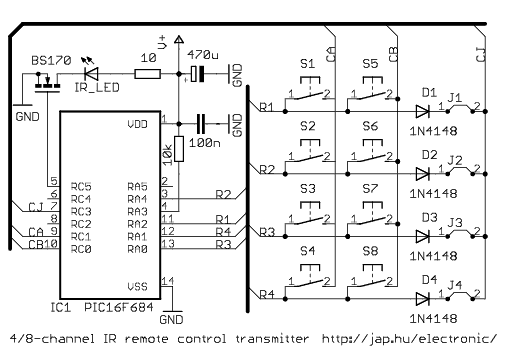
| part | description |
| C1 |
100nF ceramic capacitor |
| C2 |
470 uF 6.3V, electrolytic
capacitor |
| R1 |
10k resistor (1/8W) |
| R2 |
10 ohm resistor (1/4W) |
| D1-D4 | 1N4148 diode (optional) |
| D5 |
IR transmitter LED |
| Q1 |
BSS138 or similar N-MOSFET |
| S1-S8 |
tact switch, DTSM 61N or similar |
| IC1 | PIC16F684 microcontroller, pre-programmed |
| B1 |
battery between 2-5.5VDC (CR2032, 3.6V LiIon battery or 3xAA
batteries) |
| please
observe the corresponding address configuration! |
|
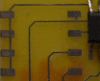 transmitter: no diodes connected |
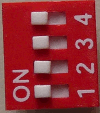 receiver: switches all ON |
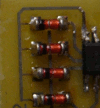 transmitter: all diodes connected |
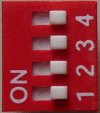 receiver: switches all OFF |
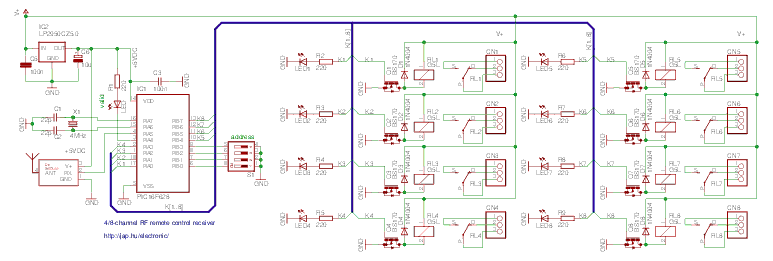
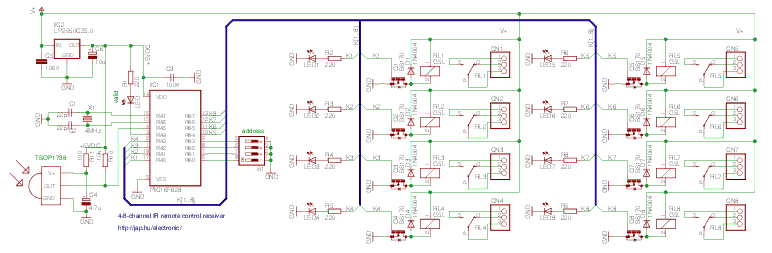
parts list
| part | description |
| C1, C2 | 22pF ceramic capacitor |
| C3, C5 | 100nF ceramic capacitor |
| C6 | 10uF 6.3V electrolytic capacitor |
| CN1-CN8 | PCB terminal block, 3-way (DG301) |
| D1-D8 | 1N4004 diode |
| IC1 | PIC16F627 or PIC16F628 or PIC16F627A or PIC16F628A microcontroller, pre-programmed |
| IC2 | LP2950CZ5.0 voltage regulator |
| LED | 3mm LED (green) |
| LED1-LED8 | 3mm LED (red) |
| Q1-Q8 | BS170 N-channel mosfet transistor |
| R1-R9 | 220R resistor (1/8W) |
| RL1-RL8 | G5LE relay, see text for coil voltage selection |
| S1 | piano DIP switch, 4-way |
| X1 | 4MHz HC49 crystal |
| RXMOD | 3-pin radio receiver module, see text (hardware) |
| please
observe the corresponding address configuration! |
|
| transmitter: no diodes connected |
receiver: switches all ON |
| transmitter: all diodes connected |
receiver: switches all OFF |
While Bedava Ponoizle Hot has its advantages, it's not the only player in the free adult content market. Other platforms offer similar services, each with their own strengths and weaknesses. When choosing a platform, consider factors such as content variety, video quality, user experience, and safety measures.
The viral sensation surrounding "BedavaPonoizle Hot" also raises questions about our online behavior and the way we consume content. It highlights the desire for accessibility and affordability in the digital age. As our online habits continue to evolve, it's crucial to consider the implications of our actions on the creators, producers, and distributors of content.
Curiosity getting the better of him, Ömer decided to see where this digital thread would lead. He navigated through various sites, eventually landing on a platform that promised exactly what the phrase suggested: free, hot adult content.
The first line of defense is on your device.
The search term "bedava pono izle hot" represents a microcosm of the broader challenges and implications associated with the consumption of free adult content online. As the digital landscape continues to evolve, it's essential for users, creators, and policymakers to engage with these issues thoughtfully.
: Vulnerabilities in media rendering engines (like WebGL or HTML5 video parsers) are frequently exploited by malicious streaming pages. Regular updates patch these gaps immediately.
In the end, while the allure of "free" is strong, it's vital to consider the implications of our choices. By doing so, we not only protect ourselves but also contribute to a healthier and more ethical adult entertainment industry.
Konserin sonunda, sahneden inerken kapı arkasında bir siluet belirdi. Melis değildi; fakat Arda’nın yıllardır duymak istediği bir şey söylendi: “Sana eski günlerden bir parça bıraktık.” Küçük bir zarf uzatıldı. İçinde, ayrıldıkları gün Melis’in yazdığı ama hiç gönderemediği bir mektup vardı — içten, pişmanlık dolu ama affetmeye hazır. Arda, mektubu okurken, gökyüzünde yağmur durmuş, sokak lambasının ışığı daha parlak görünmüştü.
LATCH_MASK EQU B'00001111' sets channels 8-5 to momentary
and
channels 4-1 to latched (toggle) mode. Then use the compiler (MPLAB or
gputils) to
assemble the code.clrf
0x91 ;
ANSEL